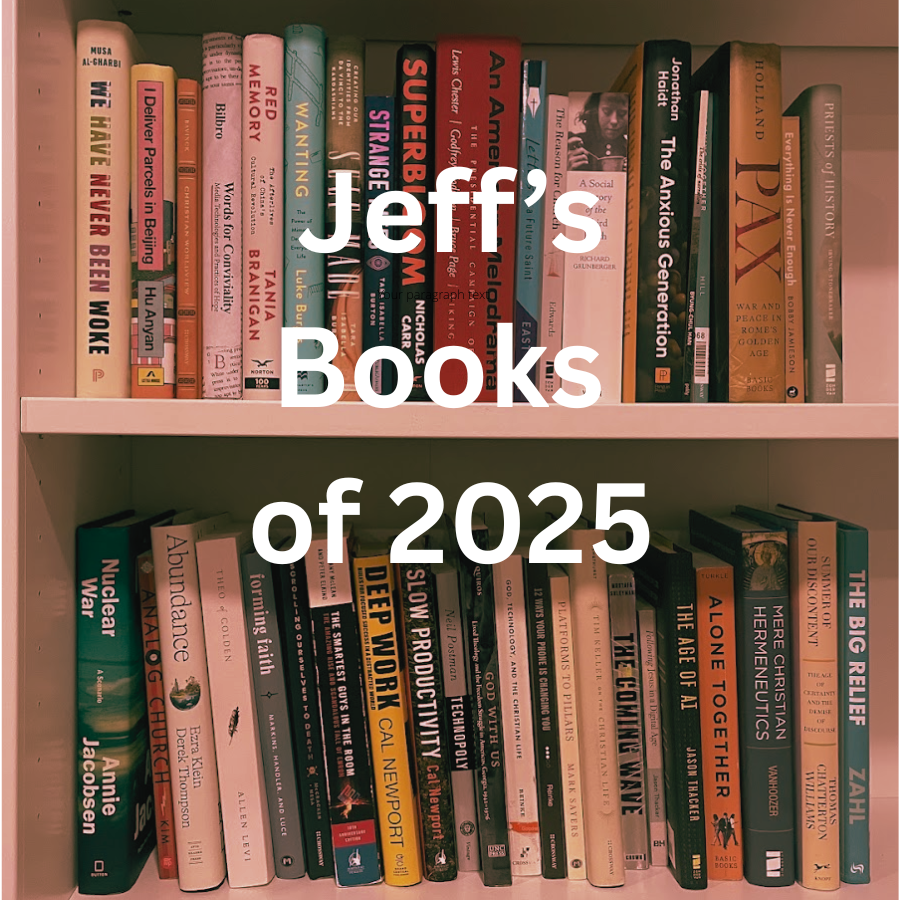
Jeff here -
One of the much-covered trends in recent years is the diminishment of reading, and what it is doing to us as we move away from a “literate society” into a “post-literate society.” Derek Thompson noted “the end of reading” as his #1 most important idea for 2026, sharing the following chart (specifically about teenagers, but the society-wide trends are well-documented):
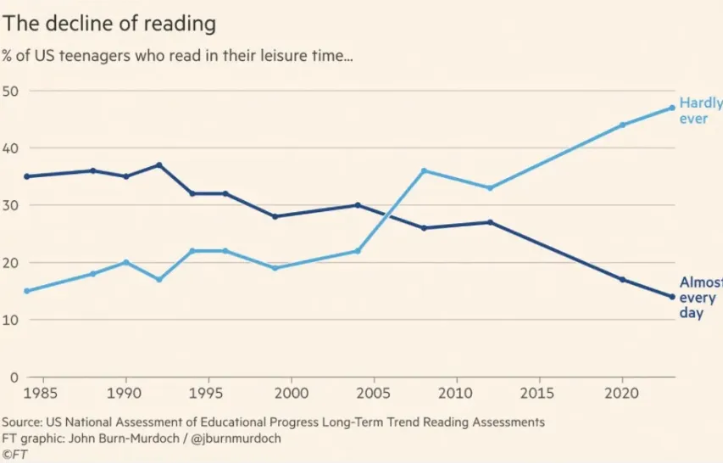
Why is this happening? It’s hard to say. Of course, the decline of reading is lamentable in many ways. However, the church has the privilege of not simply bemoaning this shift, but of seeing the opportunity therein. A well-formed Christian counterculture will be one that reads deeply and thinks deeply. I’m glad for the ways that MPC encourages reading, and I’m hopeful that we’ll have some additional ways to do so in the near future.
In the meantime, I’m happy to return to a tradition I began back in 2021 of rounding up the books I read during the year, offering you some recommendations for your own reading as you embark on the year to come. Some of these books are specifically Christian, some are not, but all helped me, in one way or another, to see the goodness of God, the wonder of the world He has made, and the deep need we have for renewal and redemption.
One final note - this year’s list is more of a reading log, not a ranking, and so mentioning the below books does not signify unqualified agreement with any of them (particularly in the books not designated as Christian). Occasionally, I’ve linked to reviews of these books from reputable Christian sources, as these reviews demonstrate a strong Christian engagement with various cultural expressions.
Having said that, for those who just want the top recommendations, I’m happy to give my top books that I most enjoyed/would recommend (details on these and more below):
Strange Rites - New Religions for a Godless World - by Tara Isabella Burton
Superbloom: How Technologies of Connection Tear Us Apart - by Nicholas G. Carr
Words for Conviviality - Media Technologies and Practices of Hope - by Jeffrey Bilbro
Christian Books
Platforms to Pillars - Trading the Burden of Performance for the Freedom of God’s Presence - by Mark Sayers - This was probably the best book I read in 2025. I really enjoy the theological and cultural insights of pastor/author Mark Sayers. He’s Australian, which gives him a certain healthy distance from the American news cycle. In this book, Sayers shows how our world forms us for a “platform” existence - continually showcasing ourselves - while the Kingdom of God is made up of people willing to humbly serve as pillars. Bonus - Sayers’ podcast - Rebuilders - is an excellent resource as well.
Tim Keller on the Christian Life - by Matt Smethurst - In 2023, right around when Tim Keller went to be with the Lord, Collin Hansen published a book on Keller’s life and intellectual/spiritual influences. This book more directly interacts with Keller’s work. Very encouraging to see a life well-lived, and a Gospel well-proclaimed.
Everything is Never Enough - Ecclesiastes’ Surprising Path to Resilient Happiness - by Bobby Jamieson - I kept hearing about this book and picked up in October when I was dealing with some health stuff and working through my Sunday school class on technology. For that reason, the way Jamieson opened his book by talking about the world’s uncontrollability (despite our best efforts) had me from the jump. Just a wonderful look at so many of the places we look for true life, which can only come from the God who made and loves us. (Yes, I know this book is competing with another good one about Ecclesiastes that just came out.)
Numbers 1-19 by L. Michael Morales - This is one of the books I worked my way through in my devotions in 2025, and it was really helpful. It allowed me to slow down in a book that I think I have typically sped through when I have read it in the past. Throughout the commentary, Morales continues to emphasize the importance of the structure and layout of Israel’s camp, an emphasis that yields valuable insights. Morales also shows how the Book of Numbers points forward to Jesus. This commentary is fairly academic at times (there were parts I just glossed over) but it could be an encouraging and challenging companion to your Bible reading in 2026.
God with Us: Lived Theology and the Freedom Struggle in Americus, Georgia, 1942–1976 by Ansley L. Quiros - Every year, I try to read at least one book that describes the intersection of church and race in America. This book is interesting in that it zooms in on one town in particular and describes the central characters therein. Quiros unpacks the paradox that she describes early in the book - “Christian theology, in the hands of some, was harnessed to preserve the segregationist system; in the hands of others, it was used to defy it. Both sides claimed God was with them.”
The Reason for Church: Why the Body of Christ Still Matters in an Age of Anxiety, Division, and Radical Individualism by Brad Edwards - Edwards lightly models this book on Tim Keller’s The Reason for God, presenting certain “defeater” arguments for why the church is no longer relevant - and posits a constructive case for why it does. Edwards draws on the work of Yuval Levin, who has written extensively about why institutions in general still matter. Specifically, the church as an institution is of utmost importance, and this book encouraged me to prayerfully and dependently focus on investing in the long-term health of the church.
Strange Rites - New Religions for a Godless World - by Tara Isabella Burton - Burton became interested in how the decline of traditional religion has led to other quasi-religions that fulfill the societal role that religion once played. As she studied this phenomenon, she was led to faith herself and is now a Christian. Part of Burton’s analysis uncovers how difficult this task of building your own religion can be - she cites a discussion she had with psychologist Phil Zuckerman, who said -
One of the biggest problems for secular culture [is that] you have to cobble together and make it yourself. If you want your kid to have a bar mitzvah, it's all taken care of. You want your kid to go through confirmation class in the Episcopal church? Boom, they're enrolled. If you want to do a secular version of that? Good luck. You're on your own. You have to figure it out, explain it to people, rent the space, find people, figure out how to write up your own program.
As we live and minister in the midst of an often-exhausted culture, it can be helpful to remember what a burden our neighbors are carrying as they attempt to find their way in the world.
Self Made - Creating Our Identities from Da Vinci to the Kardashians by Tara Isabella Burton - In this 2023 book, Burton describes how we are tasked (and burdened) with the grueling work of constructing our own identities - in a way that we have not been throughout the great majority of human history. Burton goes back centuries to show the seeds and development of this idea, culminating in the fact that, today, “social media star” is “now the fourth most desirable career for contemporary teenagers.” Burton is quick to point out, however, that this is not just a problem for the teens, but for all of us, as we breathe the air of our current culture.
12 Ways Your Phone is Changing You - by Tony Reinke - I read this book for my Sunday School class on technology, and I knew I would wince often as I did. Like many, I picked up my first iPhone in 2012 - it was issued to me by my job, it had a much more pleasing screen than my old Blackberry, and I felt continually drawn to it, sometimes for seemingly no reason. Over time, I’ve begun to understand how the phone itself (not just what I was looking at on the phone) was shaping me, and Reinke has been on the same journey (though I suspect he is a bit more tech-positive than I am). Reinke’s mere stating of what our phones do to us is bracing, and, as prominent technology critic Neil Postman has pointed out, merely asking the question is often enough to break technology’s spell. Now is a good time for us to ask hard questions of our tech use, and this book helps us to do so.
God, Technology and the Christian Life - by Tony Reinke - Here’s another, more general, book from Reinke. He notes that, when it comes to tech, Christians tend to either become dystopians (tech is destroying us) or utopians (tech will save us). This book attempts to chart an actual Christian path forward, seeing the goodness of tools in general and digital technology in particular, while warning us of technology’s limits and alerting us to its dangers. As noted above, Reinke might be more tech-positive than I would be, and he marshals the big guns (John Calvin) to build his case. As Calvin said:
If the Lord has willed that we be helped in physics, dialectic, mathematics, and other like disciplines, by the work and ministry of the ungodly, let us use this assistance. For if we neglect God's gift freely offered in these arts, we ought to suffer just punishment for our sloths.
I was helped by this book, but I’m not sure Reinke goes far enough in drawing a distinction between many historic forms of tech and the newer digital technologies that, I would argue, shape us more aggressively. Still, there’s a lot here that is helpful, and it’s possible I need to be less of an Eeyore about some of our developing technologies.
Priests of History - Stewarding the Past in an Ahistoric Age - by Sarah Irving-Stonebraker - This is another book that diagnoses a cultural problem, but, rather than simply bemoaning it, puts forth a positive vision for the church to embrace. In this case, we are urged to not jettison the past, but to deeply partake of our shared history. She says:
History is a rich storehouse—a “vast treasury,” to quote Isaac Watts—if we are wise enough to know how to use it. By tending and keeping the past, Christians can not only strengthen and revive our spiritual and intellectual formation, but we can also equip ourselves to communicate the truth, goodness, and beauty of Jesus Christ to a confused and rootless world.
One interesting note here- Stonebraker became a Christian through the ministry of friends like Rebecca McLaughlin (another popular author).
Mere Christian Hermeneutics - Transfiguring What it Means to Read the Bible Theologically - by Kevin Vanhoozer - In this well-regarded book, Vanhoozer charts a path for helping Christians to read their Bibles well. He argues that a good reading of the Bible is one that is done in an expansive theological community, with the help of other saints and other traditions. This leads us in the way of humility, and helps us to be shaped, formed and renewed by the Biblical text as we encounter it. This is a fairly academic book, but it’s also exceedingly warm and encouraging.
Words for Conviviality - Media Technologies and Practices of Hope - by Jeffrey Bilbro - This book addresses the challenges posed by technology, but does so by turning to history to see how society has been shaped by (and how the church has responded to) previous transformative technologies, especially the printed word. Honestly, this book started a bit slow for me, but really picked up as I read. Because the printed word has been ubiquitous for my whole life (and well before that), I had never considered how transformative the explosion in printing presses was, and how much panic (that almost sounds quaint now) set in as a plethora of books and other reading material made their presence known. In words that many of us have experienced over the last 10-20 years, he says - “When an individual feels that he is in control of a new communications technology, he is likely to be optimistic about its effects; but when he feels that others are beginning to wield the technology against him, pessimism ensues.” Reading this, I can’t help but wonder if we will have similar feelings about AI (see below) as it grows and develops.
Praying Together - The Priority and Privilege of Prayer in our Homes, Communities, and Churches - by Megan Hill - I picked up this book after a discussion with our elders, deacons and shepherding servants about developing a deeper culture of prayer in our church. It was encouraging to hear Hill’s history with church prayer meetings - her father being a pastor - and how she had richly benefitted from the simple step of meeting to pray with people from her church. I’m grateful for the ways we’ve been growing in prayer at MPC, and this book is a continued encouragement in that direction.
Analog Church - Why We Need Real People, Places, and Things in the Digital Age - by Jay Y. Kim - Hilariously debuting in March 2020 when churches were beginning to deal with the pandemic, Kim details the countercultural opportunity churches have to go analog, especially as it relates to worship, community, and Scripture. He says - “People are hungry for human experiences and the church is perfectly positioned to offer exactly that. In fact, the church is fundamentally designed and intended for this work—to create spaces and opportunities for people from all walks of life to experience true human flourishing, in real time and real space.
Christian Worldview - by Herman Bavinck - I really enjoyed Bavinck’s The Wonderful Works of God but struggled more with this one, which is very heavy on philosophy and interaction with other philosophies/philosophers of Bavinck’s day. Check this article out if you want to hear from a pastor who was really helped by this book. I would never discourage anyone from reading Bavinck, and I’m sure the problem was with me, but I just found this one more difficult.
The Age of AI - Artificial Intelligence and the Future of Humanity - by Jason Thacker Also written in 2020, this might be a little bit behind the times in terms of AI advances, but Thacker does a good job of laying out different areas where AI will undoubtedly have an impact - self, medicine, family, work, war, data and privacy, and so on.
Following Jesus in a Digital Age - by Jason Thacker - Thacker encourages us to towards four pursuits - wisdom in a digital age, truth in a post-truth age, responsibility in a curated age, and identity in a polarized age.
Forming Faith: Discipline the Next Generation in a Post-Christian Culture - by Matt Markins, Mike Handler and Sam Luce - A helpful book for considering how we can best care for the next generation. The authors of the book are experienced youth leaders who have begun to see actual formation (rather than simply fun) as the priority in youth ministry. They describe this formation in relational ways, with younger people enjoying strong relationships with older people in the church. I’m happy to say our excellent youth leaders already prioritize this - but I think it is good for all of us to consider how we can lovingly and appropriately pursue the younger saints in our midst. An encouraging read.
Letters to a Future Saint: Foundations of Faith for the Spiritually Hungry - by Brad East - East covers the basics of Christianity in a series of short letters, purportedly from an older saint to a younger one. I read through this as an addition to my devotionals this year, and it was encouraging and easy to digest. I have some theological disagreements with East (he is a proponent of theistic evolution, for one) but overall I find him to be helpful and clear.
The Big Relief: The Urgency of Grace for a Worn-out World by David Zahl - Zahl wrote one of my favorite books of a few years ago, Seculosity. In this newer book, Zahl takes us through nine different “reliefs” that the Gospel offers us, with an eye toward how grace encourages us in our current cultural context. Zahl is a good author and is easy to read. Similar to East, I didn’t 100% agree with every theological statement Zahl made, but overall a helpful book. You can read a fuller review here.
Scrolling Ourselves to Death: Reclaiming Life in a Digital Age - Edited by Brett McCracken and Ivan Mesa - This book is a collection of essays that pays tribute to the work of technology critic Neil Postman (whose most well-known book is entitled Amusing Ourselves to Death). Some of the essays were stronger than others, but again, an overall helpful book for us to be thoughtful about our tech use, especially as it comes to social media. There are plenty of sobering notes, but this one from Patrick Miller stands out:
Research shows that the more addicted you become to dopamine-producing behaviors, the less your brain rewards you for being in relationship with others.
Cultural Analysis
Deep Work - Rules for Focused Success in a Distracted World - by Cal Newport - Max raved about this book to me years ago - I immediately bought it and then got too distracted to read it. Finally opened it this year on vacation - found it very helpful. While this is not a Christian book, it does serve as a reminder that, in every cultural crisis, there is an opportunity for the church. This means that, as we live in a distracted world, we can encourage a degree of depth in our church services and discipleship that is countercultural. We can also bring a disposition for depth into our callings, knowing that this is one more way we can honor God as He sends us into the world.
Slow Productivity: The Lost Art of Accomplishment Without Burnout - by Cal Newport - After reading Deep Work, I was trying to keep the good Newport vibes going - but this one didn’t resonate as much with me. In fairness, I might have needed a break from this type of book. Newport gives a vision for accomplishing meaningful things and keeping away from “pseudo-productivity.” It’s not a bad message, but I found the book a bit repetitive and some of its suggestions unrealistic for people dealing with deadlines and bosses.
The Crisis of Narration by Byung-Chul Han - Han is a German philosopher who has come to prominence in recent years for his adeptness at diagnosing modern society. In this book, he discusses how contemporary societies are losing the gift and power of narration - noting that, rather than receiving and living in the shared narration of a society, we are busy digesting information, obsessing over consuming, and attempting to construct our own story. Han’s analysis has been gaining traction in Christian circles - you can check out an excellent overview of his work by Samuel D. James here.
Superbloom: How Technologies of Connection Tear Us Apart - by Nicholas G. Carr - Carr’s breakthrough came years ago when he published a much-discussed piece entitled “Is Google Making Us Stupid?” He followed that up with a book called The Shallows and now this book is specifically about connective technologies (social media, etc.) Part of Carr’s comprehensive case stems from a historical survey of other connective technologies, and how they promised great unity but delivered more confusion and division. This book talks a good deal about the telegraph, and the rampant optimism that it would deliver peace on earth (even many churches got on board with this idea!) I was really helped by this book as I prepared for my Adult Sunday School class on the formative power of technology.
Spellbound: How Charisma Shaped American History from the Puritans to Donald Trump - Understanding the idea of charisma will help us to make sense of much of our world, according to Worthen, who is an adult convert to Christianity and a professor at UNC-Chapel Hill. While charisma seems to play more and more of a role in how we choose our leaders, Worthen’s history reminds us that the roots of this phenomenon are deep. While this reads as a straightforward history of this type of leadership, Worthen does offer some explanation, which I found helpful. Why are charismatic leaders so popular? She says -
This desire springs from a paradox central to the human personality, one that has not changed much over the centuries: we all wish for a sense of personal agency, some degree of control. But that wish is enmeshed in a fear of responsibility, a corresponding urge to hand over the reins to some force greater than ourselves.
Wanting - The Power of Mimetic Desire in Everyday Life - by Luke Burgis - Burgis draws deeply on the work of Rene Girard to deliver this book, which attempts to explain how mimesis drives so much of our behavior as human beings. He details how our desires are driven by models that we find, rather than simply our own objective analysis of the situation. And, oh, how we love to find models, and oh, how many models are available to us! He says -
Models of desire are what make Facebook such a potent drug. Before Facebook, a person's models came from a small set of people: friends, family, work, magazines, and maybe TV. After Facebook, everyone in the world is a potential model.
Yes, I know the kids aren’t on Facebook anymore - but obviously this analysis applies to all types of social media. Again, simply asking the question about what’s happening to us when we deal with these “mimetic machines” will help us to resist.
The Coming Wave - AI, Power and Our Future - by Mustafa Suleyman - The goal of this book is to help prepare for people for what is to come as AI becomes a bigger part of our lives. Suleyman, an AI pioneer who is currently the CEO of Microsoft AI, believes that we are headed for disaster unless we establish sufficient guardrails to protect the flourishing of human society. Suleyman looks back to previous waves (including nuclear power, see below) to help address our current dilemma. While we can’t be sure of what AI will bring, we do know that it will cause us to wrestle with some fundamental questions and, yes, be an opportunity for the church, as Christopher Watkin contends in his excellent article about the AI “Apocalypse”.
Alone Together: Why We Expect More from Technology and Less from Each Other - by Sherry Turkle - This book came out in 2011, early in the days of the smartphone revolution. However, Turkle was ahead of her time in analyzing how our tech is changing us. In this book, she specifically (though not exclusively) addresses young people and their use of texting/Facebook. (Remember, it was 2011). She shows that the effects of these technologies are not generally good. This is a book that many of today’s technology critics cite again and again. Turkle is prescient when she says “Technology is seductive when what it offers meets our human vulnerabilities. And as it turns out, we are very vulnerable indeed. We are lonely but fearful of intimacy.” Remembering these truths will help us to understand ourselves and our neighbors in a world that has only accelerated since 2011.
Technopoly - The Surrender of Culture to Technology - by Neil Postman - This is an older book, published in 1992. Postman was one of technology’s biggest critics. Above, I mentioned Tony Reinke, who might be a little more tech-positive than me. Well, if you want the opposite extreme, check out Postman. I believe that Postman is too harsh on our technological era, but he is outstanding when it comes to describing unintended consequences. In this book, he even goes back to the invention of the clock - which was built for religious use - and shows how it ended up leaving the monastery and transforming human life along the way.
The Anxious Generation: How the Great Rewiring of Childhood Is Causing an Epidemic of Mental Illness - by Jonathan Haidt - I know many in our church have already read this book - it’s very helpful. Haidt shows how parents have over-emphasized safety in many areas (playing outside, etc.) and yet have been incredibly reckless in handing our kids over to technology. Haidt’s work seems to be making headway as parents and even schools reconsider the appropriate level of technology for our children.
Other Interesting Reads
An American Melodrama - The Presidential Election of 1968 - by Lewis Chester, Godfrey Hodgson, Bruce Page. Okay, so this is 800 pages on the 1968 election.. from a book that was written in 1969.. by a team of British journalists. Also, it’s out of print. The obstacles are worth it. A really amazing book about an incredible election season in a turbulent and formative time for the nation. Plenty of interesting anecdotes, including the authors stating that it was fair to criticize Richard Nixon as a candidate, but at least he was impeccably honest. I heard about this book when listening to The Rest is History podcast (they did a five-part series on America in 1968).
Red Memory: The Afterlives of China's Cultural Revolution - by Tania Branigan - This book looks back to the period of the Cultural Revolution in China, a time when Mao tightened control of the country by employing China’s youth in a massive cultural purge that victimized countless people. This book is specifically about how the nation continues to deal with the trauma of this time period, which is especially difficult given that the same Communist Party still controls the nation.
A Social History of the Third Reich by Richard Grunberger - While there are plenty of books about the drama and horror of World War II, this book is so fascinating because it takes you inside the “day to day” of life in the Third Reich. How people worked, how people played, and even a section on how the church functioned and responded to the Nazi regime. It’s interesting to consider how the “not normal” became “normal” very quickly for an entire nation.
Nuclear War: A Scenario by Annie Jacobsen - This was a really chilling book. Jacobsen conducted extensive interviews and did thorough research about our nation’s plans in the case of a nuclear attack. Armed with this research, she then constructs a detailed, fictional-but-realistic scenario of a nuclear attack that originates in North Korea. It was difficult to read exactly what would happen, and how unlikely it is that we could do much about it if such an attack was launched. As I read this book, I was helped by the words of GK Chesterton (quoted by Trevin Wax in his review of this book): He who has seen the whole world hanging on a hair of the mercy of God has seen the truth; we might almost say the cold truth. He who has seen the vision of his city upside-down has seen it the right way up.
Theo of Golden by Allen Levi - Like I always do, I planned to read more fiction in 2025 - and I didn’t - but I did read this, and it was excellent. Levi is a first-time author and a Christian. He tells the story of an old man who arrives without fanfare in a town named Golden, and his quiet and resilient kindness plays a redemptive role in a community full of hurting people. The ending had me in tears. You can also listen to a Gospelbound podcast featuring the author.
The Smartest Guys in the Room - The Amazing Rise and Scandalous Fall of Enron by Bethany McLean - As someone who was working in public accounting around the turn of the century, it’s hard to overstate the shock that was felt when Enron collapsed in 2001/2002, leaving incredible destruction in its wake (including the shuttering of one of the largest accounting firms in the world, Arthur Andersen). Above, I mentioned the book The Reason for Church and the importance of building healthy institutions. This book is a classic counterexample - as Enron became a place of greed and deceit - where the leadership clearly believed their own hype and continued to hear what they wanted to hear (a temptation for all leaders, including church leaders). The tale is wonderfully told by McLean, who was a reporter for Fortune magazine and worked tirelessly to unwind this story.
Pax: War and Peace in Rome’s Golden Age - by Tom Holland - I know Max loves ancient Roman history, but it’s not something I’ve ever been terribly excited about. This book was a nice introduction to the world that Jesus was born into, and provides a good overview of some interesting characters in Roman history, with really well-told anecdotes. If you already know your Roman history, you might find this book redundant - but for someone like me, it was illuminating.
I Deliver Parcels in Beijing - by Hu Anyan - A remarkable real-life log of one man’s work in several different Chinese cities (yes, including delivering parcels in Beijing). I found this interesting for the insight into work life in China, as well as for Anyan’s quest for meaning and significance in his work. As I read his concluding thoughts, I was reminded how a Christian theology of work (its goodness and its brokenness) is so helpful for all of us as we fulfill our callings.
Bonus - Good Christian Interactions with Non-Christian Books
The last three books I wanted to mention are ones that were specifically written from a non-Christian perspective - while there’s plenty to disagree with in each of these books, they were books that were somewhat prominent in this year’s cultural discourse. Each book has strengths and weaknesses, and received good interactions from reliable Christian sources, modeling how the church can interact with various cultural perspectives in a truthful and gracious way.
The Summer of Our Discontent - The Age of Certainty and the Demise of Discourse - by Thomas Chatterton Williams - A thoughtful look back to the time leading up to and including the summer of 2020, including questions of freedom of speech.
We Have Never Been Woke: The Cultural Contradictions of a New Elite - by Musa al-Gharbi - The author also looks back to recent history, including 2020, and explores the idea of “symbolic capitalism” and how this trend has deeply influenced our culture while arguably not providing much benefit to the people who the symbolic capitalists are purporting to help.
The prior two books came to me through the reviews/notes of British pastor Andrew Wilson. I try to read almost everything that Wilson recommends. I enjoyed how Wilson interacted with these books in a Gospel Coalition article about them. He says -
Neither of these books will solve those problems on its own. But both of them, and al-Gharbi’s in particular, have the capacity to challenge and inform us by reframing the narrative of that turbulent year—as long as we read them with a spirit of humility (“Is it I, Lord?”) rather than smugness (“I thank you, Lord, that I am not like that symbolic capitalist over there”). Vibes have shifted many times before. They will again. And thoughtful cold takes on the last one can help us wisely respond to the next one.
Abundance - by Ezra Klein and Derek Thompson - This book was a smash hit in 2025, particularly among liberal elites. Klein and Thompson attempt to offer a positive progressive vision for creating a more “abundant” culture.
I appreciated Christopher Watkin in his review of this book for The Gospel Coalition:
In the end, Abundance is important not because it provides the answers but because it shows so clearly the limits of political imagination when cut off from Scripture’s deeper diagnosis. Its luminous future lacks shadows. It bypasses the essential anthropology of Genesis 3 and Romans 7, which reveal we’re creatures with a propensity to sabotage even the best gifts and the most abundant futures. Our most basic social contract is fragile not primarily because we don’t have the right sort of government but because we can’t resolve the core tensions of human self-interest.
Kyle Williams also excels in his review for Mere Orthodoxy:
Perhaps lurking beneath this reductionistic account of abundance is some kind of category error—a mistake about what it means to be a human being and to flourish. The fact that this vision of 2050 is so antiseptic and boring suggests something spiritually bankrupt about it… There is little reason to think that technocratic fixes and materialistic abundance will overcome the nihilism and apathy that so thoroughly dominate our political culture.
As usual, if you have read or decide to read any of these, I’d love to hear from you and discuss!